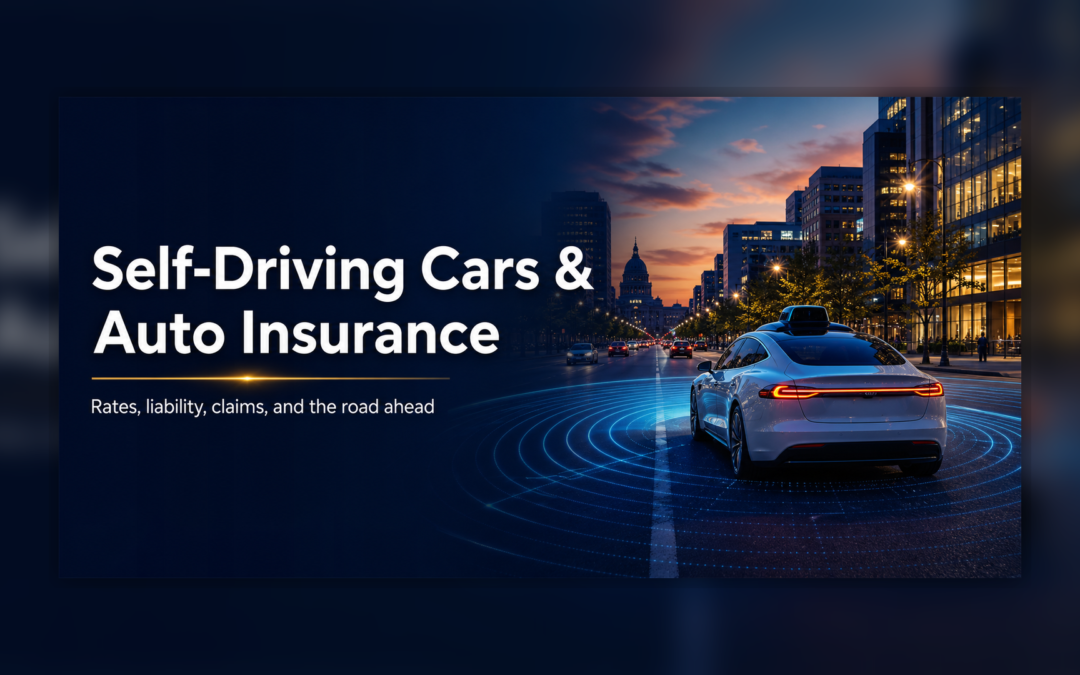
Self-Driving Cars and Auto Insurance Rates: What Autonomous Vehicles Could Change
Self-driving vehicles could eventually reduce certain crashes, change who is legally responsible after an accident, and reshape how auto insurance is priced. But the transition will probably be gradual, uneven, and more complicated than a simple promise that “cars will drive themselves and rates will drop.”
For Missouri and Kansas drivers, the near-term reality is this: most households still need traditional auto insurance, even if their vehicles include lane keeping, adaptive cruise control, automatic emergency braking, parking assistance, or other driver-assistance technology. The bigger shift is coming from a mix of autonomous taxis, connected vehicle data, electric vehicle repair costs, liability questions, and commercial fleet use.
This article looks at where self-driving vehicles are headed, when they may become common, what they could mean for auto insurance rates, and how the investment story around Tesla robotaxis compares with more familiar assets like rental real estate.
Quick Answer
Autonomous vehicles could lower some accident-related insurance costs over time if they reduce crash frequency, bodily injury claims, distracted driving, and impaired-driving losses. At the same time, premiums may not fall quickly because self-driving vehicles can be expensive to repair, rely on complex sensors and software, create new cyber and product-liability exposures, and may shift risk from individual drivers to manufacturers, software providers, fleet operators, and commercial insurance programs.
Where Self-Driving Vehicles Actually Stand in 2026
The phrase “self-driving car” can mean very different things. A vehicle with adaptive cruise control is not the same as a fully autonomous robotaxi operating without a human driver. Many vehicles on the road today offer advanced driver assistance systems, often called ADAS, but they still require an alert human driver.
The National Highway Traffic Safety Administration explains that higher levels of automation can remove the human driver from the chain of events that can lead to a crash, but the technology is still developing and is not the same across every vehicle or every road environment. In plain English: some cars can help a driver; a smaller number of vehicles can operate autonomously in limited areas; very few are ready to drive anywhere, in all weather, under all conditions.
That distinction matters for insurance. A car with lane centering may still be rated like a normal private passenger vehicle. A robotaxi operating in a geofenced city may need a very different insurance structure. A delivery fleet using autonomous vans may need commercial auto coverage, cyber considerations, contractual liability review, and a carrier that understands the exposure.
For a household in Kansas City or elsewhere in Missouri, this means the practical insurance conversation still starts with current coverage: liability limits, comprehensive and collision, uninsured motorist protection, deductibles, vehicles in the home, and whether a driver qualifies for safe-driver or bundle discounts. If you are comparing coverage now, start with Henson Agency’s Missouri auto insurance guide or the local Kansas City auto insurance page.
When Will Self-Driving Vehicles Be Ubiquitous?
It depends on what “ubiquitous” means.
If ubiquitous means “available in select major cities as a ride-hailing option,” the 2030s are a reasonable window. Robotaxi services are already operating in limited markets, and forecasts from firms such as McKinsey and BCG suggest that autonomous ride-hailing could become commercially meaningful before the end of the next decade. BCG has estimated that the global robotaxi fleet could reach hundreds of thousands to several million vehicles by 2035, depending on adoption speed, regulation, cost, and consumer trust.
If ubiquitous means “most personal vehicles can drive themselves anywhere,” the timeline is likely longer. The S&P Global Mobility view has been more cautious, pointing to gradual adoption of higher automation levels through 2035, especially for personally owned vehicles. That caution makes sense. Personal vehicles operate in suburbs, rural roads, snow, heavy rain, construction zones, school zones, gravel roads, parking lots, and edge cases that are harder to manage than a mapped robotaxi route in a controlled service area.
Our working expectation: by the mid-to-late 2030s, many consumers in major metro areas may be familiar with autonomous taxi or delivery services. By the 2040s, self-driving technology may be ordinary in more parts of daily transportation. But traditional driving, mixed traffic, and human-operated vehicles will probably remain part of the insurance landscape for a long time.
That mixed environment is important. Insurance does not price a dream version of the future. It prices today’s actual risk, claims data, repair costs, legal environment, and vehicle usage.
Why Autonomous Vehicles Could Reduce Some Accident Costs
The hopeful case for self-driving vehicles is straightforward: human drivers make mistakes. We get distracted, fatigued, impatient, impaired, aggressive, confused, and overconfident. If autonomous systems can reliably avoid those errors, they could reduce crashes and claims.
There is early evidence that high-performing autonomous systems can reduce certain claim frequencies in controlled use cases. Waymo and Swiss Re published a study comparing Waymo’s liability claims experience with human-driver baselines built from insurance data. The study reported materially fewer bodily injury and property damage claims for Waymo’s autonomous miles compared with the expected human-driver baseline in similar locations. That is a serious signal because it uses insurance claims, not just marketing language.
However, the insurance industry will not assume every autonomous vehicle performs like the best data set from one company. Carriers will want to know:
- Which system is driving?
- Where does it operate?
- Does a human monitor or safety driver remain involved?
- How many miles has the system driven in comparable environments?
- What happens in weather, construction, emergency scenes, and unusual road conditions?
- Who is responsible when software, sensors, mapping, maintenance, or driver supervision fails?
If crash frequency goes down, that should eventually matter for insurance pricing. But pricing also depends on claim severity. A vehicle that crashes less often but costs far more to repair may not produce the premium drop consumers expect.
Why Rates May Not Drop as Fast as People Expect
Self-driving technology can reduce some kinds of losses while increasing or complicating others. A modern vehicle with cameras, radar, lidar, high-voltage EV components, specialized glass, calibration needs, and proprietary software may be much more expensive to repair after even a minor incident.
That creates a tension: fewer accidents could lower loss frequency, but higher repair costs could raise loss severity. An insurer may care about both. If a bumper repair becomes a sensor replacement, camera calibration, software validation, and specialized labor event, the average physical damage claim can remain expensive even if crashes become less common.
That is one reason drivers should not assume advanced technology automatically means cheaper coverage. It may help with safety scoring or accident avoidance, but the vehicle’s replacement cost, repair ecosystem, parts availability, labor rate, and claim complexity still matter. Henson’s guide on how to lower your auto insurance premium is still relevant because many traditional rating factors will not disappear overnight.
For Missouri drivers, the same logic applies to location, liability limits, vehicle use, deductibles, claims history, and bundle opportunities. If you want a local view of rating factors, Henson’s Kansas City auto insurance rates guide is a useful companion to this future-looking article.
Liability May Shift From Drivers to Systems
Traditional auto insurance is built around the human driver. Who was driving? Were they at fault? Were they distracted? Did they follow traffic laws? Did they maintain control?
Autonomous vehicles complicate those questions. If a vehicle is operating itself, a claim may involve the vehicle owner, software developer, automaker, sensor supplier, mapping provider, maintenance vendor, fleet operator, or remote assistance team. Liability could shift from ordinary driver negligence toward product liability, commercial auto, technology errors, contractual indemnity, and fleet-level risk management.
This is where personal auto and commercial auto insurance may begin to diverge more sharply. A household using driver-assistance technology is still usually dealing with personal auto coverage. A company operating autonomous delivery vehicles or robotaxis may need policies designed for business use, hired and non-owned auto exposures, fleet operations, general liability, cyber risk, and contractual requirements.
For business owners, the practical question is not just “Is the car autonomous?” It is “How is the vehicle used, who benefits from the trip, who controls the system, and what contract governs the risk?” Henson’s general liability insurance page is a good starting point for understanding why business risk often extends beyond the vehicle itself.
Personal Auto Insurance Could Become More Usage-Based
Autonomous and connected vehicles produce data. They can track miles, speed, braking, following distance, time of day, location patterns, system engagement, and driver intervention. Insurers already use telematics in many markets. More automation could accelerate that shift.
In the future, two drivers with the same vehicle may not be priced the same way if one drives manually during high-risk times and the other mostly uses approved autonomous modes in low-risk conditions. A policy might eventually distinguish between:
- Human-driven miles
- Assisted-driving miles
- Fully autonomous miles
- Personal use
- Commercial or rideshare use
- Fleet-managed use
That could make pricing more accurate, but it also raises privacy and transparency questions. Drivers may want lower rates for safer behavior, but they may not want every trip analyzed. Regulators and insurers will have to balance data usefulness, consumer consent, fairness, and explainability.
For households, this is another reason to review policy choices with a human advisor instead of buying only on price. Henson Agency can help Missouri and Kansas drivers compare coverage, limits, deductibles, and carrier fit through the broader auto insurance hub.
What About Tesla Robotaxis?
Tesla’s robotaxi story is one of the most watched examples because it connects technology, transportation, insurance, and investing. Tesla’s official robotaxi pages describe service in parts of Texas, and the company’s longer-term vision has included a network where vehicles may eventually generate income when owners are not using them.
That idea is powerful: a car changes from a depreciating personal asset into a potential revenue-producing machine. If a Tesla owner could send a vehicle into a robotaxi network while they are at work or asleep, the vehicle might function more like a tiny transportation business.
But there are major unknowns. Revenue would depend on regulatory approval, vehicle eligibility, geography, utilization, charging cost, cleaning, maintenance, depreciation, insurance requirements, platform fees, downtime, consumer demand, and whether the owner or Tesla bears different kinds of liability. The investment appeal is real, but so is the uncertainty.
From an insurance standpoint, a personal vehicle used as a robotaxi is not just “a car with better software.” It may become a commercial exposure. That could require different coverage, different underwriting, different limits, and very clear policy language. A standard personal auto policy is generally not designed to insure a vehicle operating as a paid transportation service.
That does not mean the model cannot work. It means owners should treat it like a business question, not a gadget question. If the vehicle is earning money from the public, the insurance conversation changes.
Tesla Robotaxi Investing vs Real Estate Investing
The Tesla-owner robotaxi idea is often compared to rental property investing because both involve buying an asset and hoping it produces income. The comparison is useful, but not perfect.
A rental property has location risk, vacancy risk, tenant risk, repair risk, financing risk, insurance risk, property tax risk, and management complexity. But it also has a long-established legal and financing structure. Investors can compare rents, cap rates, expenses, appreciation, mortgage terms, and management costs. A buyer can work with a lender such as 360 Mortgage for DSCR rental property financing when the strategy is based on rental income rather than traditional owner-occupied underwriting.
A robotaxi investment would have a different profile. It may have lower entry cost than real estate, but it also may depreciate faster, rely heavily on a single technology platform, require regulatory approval, and face uncertain insurance pricing. Instead of tenants and leases, the owner would depend on ride demand, platform rules, service areas, charging logistics, and utilization.
Real estate investors also commonly use professional help to reduce operational friction. For example, an owner buying a rental property may compare self-management with Blue Castle leasing and property management services to handle leasing, screening, rent collection, maintenance coordination, and tenant communication. A future robotaxi owner may need a different kind of operational partner: fleet maintenance, software compliance, cleaning, charging, claims handling, and commercial insurance support.
The larger lesson is the same: do not confuse gross revenue with profit. Whether you are buying a rental house or hoping a vehicle can earn robotaxi income, the real question is net return after financing, depreciation, repairs, downtime, insurance, taxes, management, and risk.
This article is not investment advice, insurance advice for a specific policy, or a recommendation to buy or sell any security, vehicle, or property. It is a framework for thinking about risk.
How Accident Rates Could Change
If autonomous systems mature, accident rates could change in several ways.
Distracted-driving crashes could decline. A fully autonomous system does not text, eat, argue, scroll, or look away from the road. That alone could be meaningful if the system performs reliably.
Impaired-driving losses could fall. Robotaxis could reduce the need for people to drive after drinking, taking medication, or being too tired. That may affect bodily injury claims, fatal crashes, and liability severity over time.
Low-speed urban crashes may change shape. Robotaxis may be cautious in dense environments, but urban driving includes pedestrians, cyclists, delivery vehicles, emergency vehicles, and unpredictable road users. Claim frequency and severity will depend heavily on the system and city.
Weather and edge-case crashes may remain stubborn. Snow, heavy rain, glare, faded lane markings, construction detours, unusual traffic control, and emergency scenes can still challenge automated systems. Kansas and Missouri weather may matter differently than Phoenix or parts of California.
Repair costs could offset some savings. Even if crashes fall, a sensor-heavy vehicle may be costly to restore properly after a loss. Calibration and parts availability can affect claim severity.
The bottom line: the best autonomous systems may reduce claims, but insurance rates will follow credible loss data, not broad industry promises.
How Auto Insurance Relationships Could Change
Today, most consumers think of auto insurance as a relationship between the driver, the vehicle, and the insurer. In a more autonomous future, that relationship could expand.
- Automakers may take a larger role because software and hardware performance could drive losses.
- Fleet operators may buy commercial policies covering many vehicles instead of each owner buying a simple personal policy.
- Software providers may face contractual or product-liability questions.
- Repair networks may become more important because calibration quality can affect future safety.
- Data providers may influence rating because driving mode, mileage, and system engagement could become underwriting inputs.
That shift could also make umbrella insurance more important for some households and business owners. Higher liability limits may matter when a household has significant assets, teenage drivers, multiple vehicles, rental property, or business activities. Umbrella coverage will not solve every autonomous-vehicle issue, but it is part of a broader risk conversation.
For claims education, Henson’s auto, home, and renters insurance claims guide is a useful reminder that coverage is tested at claim time, not quote time.
What Drivers Should Do Now
You do not need to wait for a fully autonomous future to make smarter insurance decisions today.
- Review liability limits. Minimum coverage may not be enough if you cause a serious accident.
- Understand comprehensive and collision deductibles. Advanced vehicles can be expensive to repair.
- Ask how driver-assistance features affect rating. Some carriers may value safety features differently.
- Be honest about vehicle use. Delivery, rideshare, business errands, and paid transportation can change coverage needs.
- Compare bundle options. A home and auto insurance bundle can sometimes improve pricing and simplify account management.
- Re-shop periodically. Vehicle technology, carrier appetite, claims trends, and state rating rules evolve.
Most importantly, do not assume the cheapest policy is the best policy. A low premium with weak limits, missing endorsements, or the wrong usage classification can become expensive after a claim.
What Business Owners Should Watch
Autonomous vehicles may reach business use cases before they become ordinary in every household. Delivery, logistics, shuttle services, robotaxi fleets, construction-site vehicles, and specialized transport could all create new insurance questions.
If a business uses vehicles, the owner should review:
- Whether vehicles are personally or commercially owned
- Whether employees, contractors, or software systems operate them
- Who is responsible for maintenance and calibration
- Whether contracts require specific insurance limits
- Whether cyber, technology, or product-related exposures exist
- How claims would be handled if software or remote operation played a role
For companies with vehicles, the starting point is still commercial auto insurance. But future autonomous operations may require a broader risk review that includes general liability, contractual risk, umbrella or excess liability, workers compensation, and cyber considerations.
Will Self-Driving Cars Make Insurance Cheaper?
Eventually, maybe. Automatically, no.
The most likely outcome is uneven pricing. Some autonomous use cases may produce lower claim frequency and better fleet-level loss results. Some vehicles may remain expensive to repair. Some operators may qualify for favorable commercial pricing because they control maintenance, geography, software updates, and driverless operations. Some consumers may see little near-term change because they still drive in mixed traffic with traditional risks.
Insurance pricing will follow credible evidence. If autonomous systems prove safer across millions and then billions of comparable miles, claim data should influence rates. But if repair severity, litigation, product-liability disputes, or cyber risks rise, those costs will also be priced into the system.
For now, the smart move is to treat autonomy as one factor in a larger insurance picture. The best policy is still the one that fits the driver, vehicle, use, location, assets, and realistic claim scenarios.
Review Your Auto Insurance Before the Future Arrives
Whether you drive a traditional vehicle, an EV with advanced driver assistance, or a business vehicle with new technology, Henson Agency can help you compare coverage options and avoid assumptions that create gaps.
Frequently Asked Questions
Will self-driving cars lower auto insurance rates?
They could lower some rates over time if they reduce crashes and claims. But rates may not fall quickly because autonomous and electric vehicles can be expensive to repair, and liability may shift toward manufacturers, software providers, fleet operators, or commercial policies.
Do I still need auto insurance if my car has self-driving features?
Yes. Driver-assistance features do not eliminate the need for auto insurance. Most vehicles still require a human driver, and state insurance requirements, lender requirements, liability exposure, and physical damage risks still apply.
Would a robotaxi need personal or commercial auto insurance?
A vehicle used to transport paying passengers may create a commercial exposure. Coverage would depend on the platform, ownership structure, state rules, policy language, and who is responsible for operation. A standard personal auto policy is generally not built for paid transportation use.
When will autonomous vehicles be common?
Robotaxis may become common in selected major metro areas during the 2030s. Fully autonomous personal vehicles that can operate almost anywhere may take longer, potentially into the 2040s, because weather, regulation, cost, infrastructure, consumer trust, and mixed traffic all matter.
Coverage availability, pricing, exclusions, and underwriting vary by carrier and policy. This article is for general education only and does not modify or describe all terms of any insurance policy. Investment-related discussion is hypothetical and should not be treated as financial advice.